Diploma in Computer Financial Accounting

Build Professional Accounting Skills with Diploma in Computer Financial Accounting (DCFA)
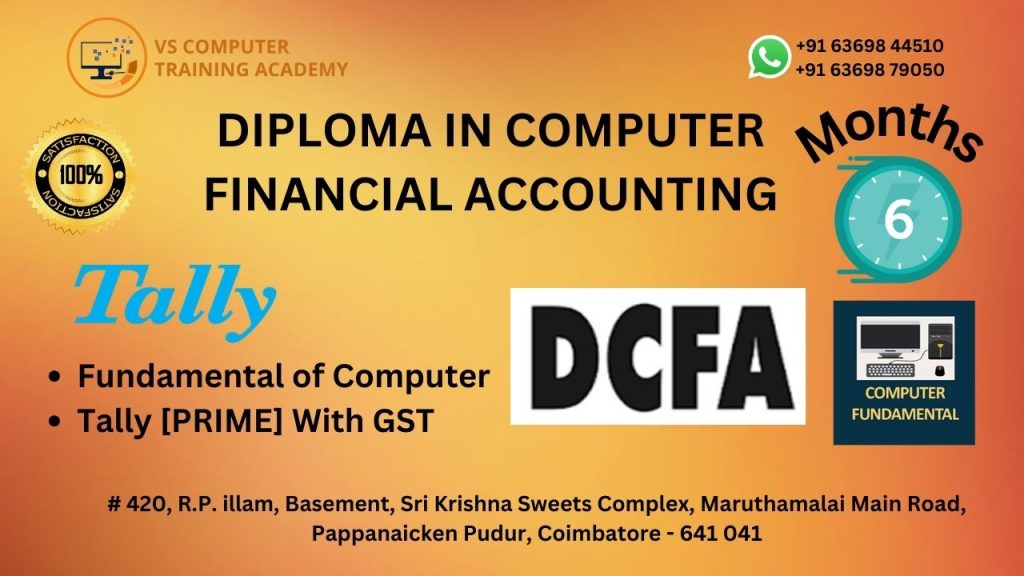
The Diploma in Computer Financial Accounting (DCFA) course at VS Computer Training Academy is designed for students, job seekers, and professionals who want to build strong skills in computerized accounting and financial management. This course provides practical knowledge of accounting principles along with hands-on training using modern accounting software.

Through this program, students will learn the fundamentals of financial accounting, GST concepts, billing, inventory management, and computerized accounting systems. The course focuses on practical applications, enabling learners to efficiently manage business accounts, prepare financial reports, and handle daily accounting operations.

Whether you want to work in accounting departments, manage financial records for a business, or start a career in finance and taxation, this course provides the essential knowledge and practical skills needed in today’s business environment.


Why Choose This Course?

Beginner-Friendly Training: Suitable for learners with basic computer knowledge
Practical Accounting Skills: Hands-on training with real accounting tasks
Industry-Relevant Knowledge: Learn modern computerized accounting methods
Expert Trainers: Guidance from experienced accounting professionals
Career Support: Preparation for jobs in accounting and finance fields


Ideal for

  • Students interested in accounting and finance

  • Commerce students and graduates

  • Job seekers looking for accounting-related roles

  • Small business owners managing financial records

  • Individuals planning a career in finance and taxation


Career Opportunities

After completing this course, you can explore roles such as:

  • Accounts Executive

  • Accounts Assistant

  • Billing Executive

  • GST Assistant

  • Accounts Clerk

  • Computerized Accountant


Completing the Diploma in Computer Financial Accounting (DCFA) opens opportunities in accounting firms, business organizations, retail companies, and financial service providers. Start your accounting career with VS Computer Training Academy and gain the practical financial skills needed for today’s business world.
Course Syllabus

Module

1) Introduction to Financial Accounting

  • Overview of financial accounting
  • Generally Accepted Accounting Principles (GAAP)
  • Accounting systems and processes
  • 2) Accounting Process

  • Journal entries and their recording
  • Ledger accounts and posting
  • Trial balance preparation and verification
  • 3) Accounting Standards

  • Understanding and applying accounting standards
  • International Financial Reporting Standards (IFRS) and Indian Accounting Standards (Ind AS)
  • 4) Reconciliation Statements

  • Bank reconciliation statement
  • Debtors and creditors reconciliation statement
  • 5) Preparation of Accounts

  • Preparation of trading, profit and loss accounts
  • Balance sheet preparation
  • 6) Accounting for Depreciation, Depletion, Amortization, and Impairment of Assets

  • Depreciation methods and calculations
  • Treatment of depletion, amortization, and impairment of assets
  • 7) Preparation of Financial Statements

  • Statement of cash flows
  • Statement of changes in equity
  • 8) Partnership

  • Accounting for partnerships: formation, admission, retirement, and dissolution
  • Partnership final accounts
  • 9) Branch and Departmental Accounts

  • Accounting for branch and departmental transactions
  • Preparation of branch and departmental accounts
  • 10) Royalty and Hire-Purchase

  • Accounting for royalty transactions
  • Hire-purchase agreements and accounting treatment
  • 11) Control of Accounting Systems

  • Internal control and its significance
  • Control accounts and subsidiary ledgers
  • 12) Self-Balancing Ledgers and Sectional Balancing Ledgers

  • Self-balancing ledgers and their use
  • Sectional balancing ledgers for cost control
  • 13) Accounting in Service Sectors

  • Accounting principles and practices for service-based businesses
  • Accounting for non-profit organizations
  • 14) Accounting for Special Transactions

  • Consignment accounting
  • Joint ventures and their accounting treatment
  • 15) Accounting for Banking, Electricity, and Insurance Companies

  • Specific accounting requirements for banking, electricity, and insurance sectors
  • Regulatory compliance and reporting