Computer classes for 6 years to 12 years
Course Overview
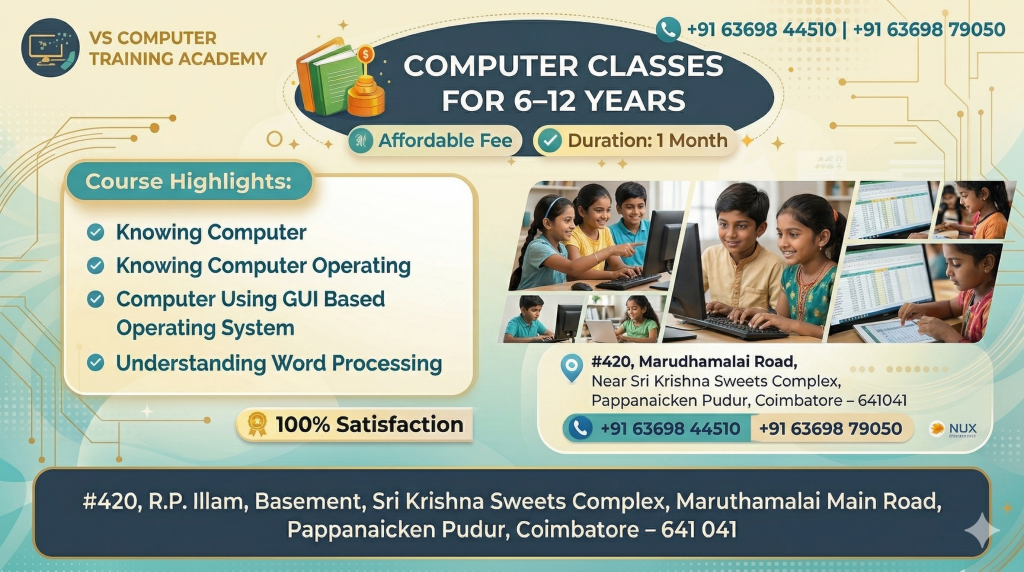
This beginner-level course focuses on introducing children to the fundamentals of computers through interactive teaching methods and practical activities. The lessons are designed to be easy to understand, keeping in mind the learning pace of young students.
Children will gain hands-on experience and develop essential digital skills that will support their academic growth and future learning.
What Your Child Will Learn
- Introduction to Computers and their uses
- Identifying parts of a computer (Monitor, CPU, Keyboard, Mouse)
- Basic computer operations (Start, Shutdown, Open programs)
- Understanding GUI (Graphical User Interface)
- Mouse handling skills (Click, Double-click, Drag & Drop)
- Basic keyboard usage and typing practice
- Introduction to word processing (typing simple text, formatting basics)
- Fun activities like drawing and simple computer games for learning
Course Duration
1 Month (Beginner Level Program)
Flexible batches available for school students
Teaching Methodology
- Interactive and child-friendly teaching approach
- Step-by-step guidance for easy understanding
- Practical sessions for every topic
- Activity-based learning to keep children engaged
- Individual attention for each student
Why Choose VS Computer Training Academy?
- Experienced and friendly trainers
- Safe and comfortable learning environment
- Focus on both learning and fun
- Practical-based training for better understanding
- Proven track record of student satisfaction
Benefits for Your Child
- Builds early digital literacy
- Improves logical thinking and creativity
- Boosts confidence in using computers
- Helps in school projects and assignments
- Prepares children for advanced computer learning
Who Can Join?
- Kids aged between 6 to 12 years
- School students with little or no computer knowledge
- Beginners who want to learn computers in a fun way
Give Your Child a Smart Start in Technology
Enroll your child today at VS Computer Training Academy and help them develop essential computer skills for the future in a fun and engaging environment.
📞 Contact: +91 63698 44510 / +91 63698 79050
📍 Location: Coimbatore
Course Syllabus
Module
1. KNOWING COMPUTER
1.0 Introduction
1.1 Objectives
1.2 What is Computer?
1.3 Basic Applications of Computer
1.4 Components of Computer System
1.5 Central Processing Unit
1.6 Keyboard, mouse and VDU
1.7 Other Input devices
1.8 Other Output devices
1.9 Computer Memory
1.10 Concept of Hardware and Software
1.11 Hardware
1.12 Software
1.13 Application Software
1.14 Systems software
1.15 Concept of computing, data and information
1.16 Connecting keyboard, mouse, monitor and printer to CPU
1.17 Checking power supply
1.18 Summary
2. OPERATING COMPUTER USING GUI BASED OPERATING SYSTEM
2.0 Introduction
2.1 Objectives
2.2 Basics of Operating System
2.3 Operating system
2.4 Basics of popular operating system (LINUX, WINDOWS)
2.5 The User Interface
2.6 Task Bar
2.7 Icons
2.8 Menu
2.9 Running an Application
2.10 Operating System Simple Setting
2.11 Changing System Date And Time
2.12 Changing Display Properties
2.13 To Add Or Remove A Windows Component
2.14 Changing Mouse Properties
2.15 Adding and removing Printers
2.16 File and Directory Management
2.17 Creating and renaming of files and directories
2.18 Common utilities
2.7 Summary
3. UNDERSTANDING WORD PROCESSING
3.0 Introduction
3.1 Objectives
3.2 Word Processing Basics
3.3 Opening Word Processing Package
3.4 Menu Bar
3.5 Using The Help
3.6 Using The Icons Below Menu Bar
3.7 Opening and closing Documents
3.8 Opening Documents
3.9 Save and Save as
3.10 Page Setup
3.11 Print Preview
3.12 Printing of Documents
3.13 Text Creation and manipulation
3.14 Document Creation
3.15 Editing Text
3.16 Text Selection
3.17 Cut, Copy and Paste
3.18 Spell check
3.19 Thesaurus
3.20 Formatting the Text
3.21 Font and Size selection
3.22 Alignment of Text
3.23 Paragraph Indenting
3.24 Bullets and Numbering
3.25 Changing case
3.26 Table Manipulation
3.27 Draw Table
3.28 Changing cell width and height
3.29 Alignment of Text in cell
3.30 Delete / Insertion of row and column
3.31 Border and shading
3.32 Summary
4.0 Introduction
4.1 Objectives
4.2 Basics
4.3 Using PowerPoint
4.4 Opening A PowerPoint Presentation
4.5 Saving A Presentation
4.6 Creation of Presentation
4.7 Creating a Presentation Using a Template
4.8 Creating a Blank Presentation
4.9 Entering and Editing Text
4.10 Inserting And Deleting Slides in a Presentation
4.11 Preparation of Slides
4.12 Inserting Word Table or An Excel Worksheet
4.13 Adding Clip Art Pictures
4.14 Inserting Other Objects
4.15 Resizing and Scaling an Object
4.16 Presentation of Slides
4.17 Viewing A Presentation
4.18 Choosing a Set Up for Presentation
4.19 Printing Slides And Handouts
4.20 Slide Show
4.21 Running a Slide Show
4.22 Transition and Slide Timings
4.23 Automating a Slide Show
4.7 Summary
5. INTRODUCTION TO INTERNET, WWW AND WEB BROWSERS
5.0 Introduction
5.1 Objectives
5.2 Basic of Computer Networks
5.3 Local Area Network (LAN)
5.4 Wide Area Network (WAN)
5.5 Internet
5.6 Concept of Internet
5.7 Connecting to the Internet
5.8 Web Browsing Softwares
5.9 Popular Web Browsing Softwares
5.10 Search Engines
5.11 Printing Web Pages
5.12 Understanding URL
5.13 Surfing the web
1.0 Introduction
1.1 Objectives
1.2 What is Computer?
1.3 Basic Applications of Computer
1.4 Components of Computer System
1.5 Central Processing Unit
1.6 Keyboard, mouse and VDU
1.7 Other Input devices
1.8 Other Output devices
1.9 Computer Memory
1.10 Concept of Hardware and Software
1.11 Hardware
1.12 Software
1.13 Application Software
1.14 Systems software
1.15 Concept of computing, data and information
1.16 Connecting keyboard, mouse, monitor and printer to CPU
1.17 Checking power supply
1.18 Summary
2. OPERATING COMPUTER USING GUI BASED OPERATING SYSTEM
2.0 Introduction
2.1 Objectives
2.2 Basics of Operating System
2.3 Operating system
2.4 Basics of popular operating system (LINUX, WINDOWS)
2.5 The User Interface
2.6 Task Bar
2.7 Icons
2.8 Menu
2.9 Running an Application
2.10 Operating System Simple Setting
2.11 Changing System Date And Time
2.12 Changing Display Properties
2.13 To Add Or Remove A Windows Component
2.14 Changing Mouse Properties
2.15 Adding and removing Printers
2.16 File and Directory Management
2.17 Creating and renaming of files and directories
2.18 Common utilities
2.7 Summary
3. UNDERSTANDING WORD PROCESSING
3.0 Introduction
3.1 Objectives
3.2 Word Processing Basics
3.3 Opening Word Processing Package
3.4 Menu Bar
3.5 Using The Help
3.6 Using The Icons Below Menu Bar
3.7 Opening and closing Documents
3.8 Opening Documents
3.9 Save and Save as
3.10 Page Setup
3.11 Print Preview
3.12 Printing of Documents
3.13 Text Creation and manipulation
3.14 Document Creation
3.15 Editing Text
3.16 Text Selection
3.17 Cut, Copy and Paste
3.18 Spell check
3.19 Thesaurus
3.20 Formatting the Text
3.21 Font and Size selection
3.22 Alignment of Text
3.23 Paragraph Indenting
3.24 Bullets and Numbering
3.25 Changing case
3.26 Table Manipulation
3.27 Draw Table
3.28 Changing cell width and height
3.29 Alignment of Text in cell
3.30 Delete / Insertion of row and column
3.31 Border and shading
3.32 Summary
4.0 Introduction
4.1 Objectives
4.2 Basics
4.3 Using PowerPoint
4.4 Opening A PowerPoint Presentation
4.5 Saving A Presentation
4.6 Creation of Presentation
4.7 Creating a Presentation Using a Template
4.8 Creating a Blank Presentation
4.9 Entering and Editing Text
4.10 Inserting And Deleting Slides in a Presentation
4.11 Preparation of Slides
4.12 Inserting Word Table or An Excel Worksheet
4.13 Adding Clip Art Pictures
4.14 Inserting Other Objects
4.15 Resizing and Scaling an Object
4.16 Presentation of Slides
4.17 Viewing A Presentation
4.18 Choosing a Set Up for Presentation
4.19 Printing Slides And Handouts
4.20 Slide Show
4.21 Running a Slide Show
4.22 Transition and Slide Timings
4.23 Automating a Slide Show
4.7 Summary
5. INTRODUCTION TO INTERNET, WWW AND WEB BROWSERS
5.0 Introduction
5.1 Objectives
5.2 Basic of Computer Networks
5.3 Local Area Network (LAN)
5.4 Wide Area Network (WAN)
5.5 Internet
5.6 Concept of Internet
5.7 Connecting to the Internet
5.8 Web Browsing Softwares
5.9 Popular Web Browsing Softwares
5.10 Search Engines
5.11 Printing Web Pages
5.12 Understanding URL
5.13 Surfing the web